


Where RFID can make the difference
Why even sophisticated retail operations can struggle to keep physical inventory and digital systems aligned during peak demand.
India’s festive retail season is a test of more than sales performance. It tests how quickly retailers can execute the physical operations behind every transaction.
In October 2026, Unicommerce reported a 31% year-on-year increase in ecommerce order volumes during the first week of festive sales, based on an analysis covering more than 33 million order items across comparable periods in 2025 and 2026. Quick-commerce volumes grew 85%, while online marketplaces and brand websites recorded growth of 26% and 27%, respectively.
These figures don’t mean every retailer experienced the same increase. But they illustrate the intensity of demand that retail and ecommerce operations must be prepared to handle.
And that raises an interesting question.
What happens when a retailer’s inventory systems are functioning as intended, but the physical processes supplying those systems with information cannot always keep pace?
A well-managed operation can still encounter a visibility gap
Consider a large fashion retailer preparing for a festive promotion.
Its distribution centres operate with established warehouse management systems. Stores use barcode-based receiving and stock reconciliation. Sales, replenishment and ecommerce orders are coordinated through integrated enterprise systems.
This is not an operation struggling because it lacks inventory management technology.
Under ordinary trading conditions, its processes may be highly reliable.
Now consider what happens during a busy promotional weekend.
A popular garment arrives at a store, is received correctly and enters the available inventory balance. Some units move to the sales floor, others remain in the backroom. Store associates replenish popular sizes throughout the day while also assisting customers and preparing online orders.
By late afternoon, the system shows that two units of a particular size remain available.
An online order is allocated to the store. The associate goes to pick the product but cannot find it in the expected location.
The inventory record may be wrong. Alternatively, the product may be somewhere else in the store, or its physical movement may not have been reflected in the latest available information.
The retailer already has procedures for resolving such discrepancies. But during a promotional rush, locating two garments may compete with dozens of other time-sensitive tasks.
The order must now be delayed, reallocated or cancelled.

This is an illustrative scenario, not a documented incident. But it highlights a distinction that matters increasingly as retailers connect physical stores with digital fulfilment.
A system can process inventory transactions correctly without necessarily having sufficiently recent evidence of where every physical item is.
The challenge is not always the sophistication of the software. Sometimes it is the frequency, effort and reliability of physical verification.
Peak demand changes the time available to recover
Inventory discrepancies are not unique to festive retail. Mature retailers already anticipate them through cycle counts, stock adjustments, exception reporting and established operational controls.
What changes during peak demand is the environment in which those controls must operate.
A missing product discovered during a quiet trading period may be located before another customer requests it. During a festive promotion, several transactions may occur before the discrepancy can be investigated.
At the same time, replenishment becomes more frequent, store teams have competing priorities, and fulfilment commitments become more time-sensitive.
A small discrepancy can therefore affect several subsequent decisions.
Consider a product recorded as available in a store. An ecommerce order is assigned to that location, but the item cannot be found. The order is reassigned to another store, adding fulfilment effort and potentially delaying dispatch. Meanwhile, the original location may continue to show stock until the discrepancy is resolved.
The operational cost is no longer limited to correcting an inventory record. It includes the work required to recover from decisions made using that record.
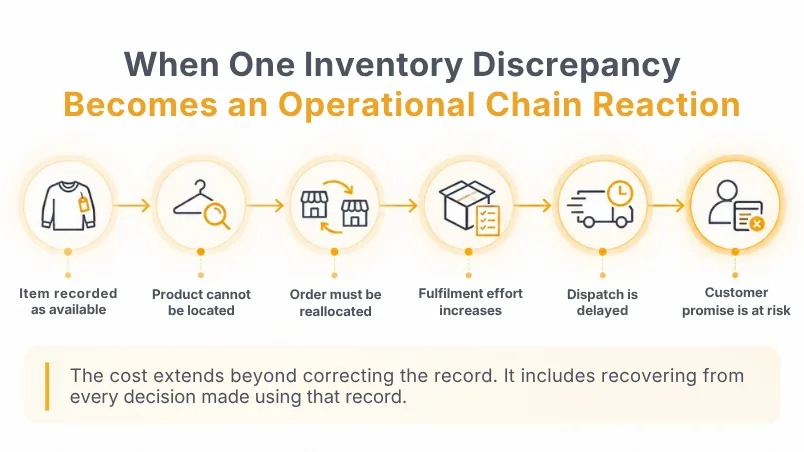
This distinction matters because the problem is not necessarily that retailers need to eliminate every discrepancy. That would be an unrealistic and potentially uneconomic objective.
The more useful question is whether discrepancies can be detected and resolved quickly enough to prevent them from disrupting customer-facing operations.
What does the evidence tell us?
Research suggests that inventory record inaccuracies remain commercially relevant even in established retail environments.
A 2025 study by Yacine Rekik and fellow researchers examined approximately 24,000 SKUs across 11 grocery stores. It found that inventory record inaccuracies were associated with factors including inventory levels and restocking frequency.
The researchers also examined the effect of physical inventory audits. Their field analysis found an 11% store-wide sales increase following an audit, with the benefit concentrated in products where system inventory exceeded actual stock.
The result should not be generalised across every retail category or interpreted as a guaranteed benefit of RFID. The study examined inventory audits, not an RFID deployment.
Its significance is more fundamental: inventory verification can have commercial consequences beyond administrative stock accuracy.
It also illustrates why verification effort should be directed towards the discrepancies that matter, rather than treating every inventory difference as equally important.
For a retailer managing thousands of products across multiple locations, that distinction is critical.
Where existing inventory processes encounter their limits
Barcode-based inventory management can be highly accurate. It is also deeply embedded in modern retail operations for good reasons.
But barcode verification generally requires individual items or their labels to be presented for scanning. The process works well at controlled points such as receiving, checkout and structured warehouse operations.
The difficulty can arise when retailers need to verify large numbers of individual products frequently, particularly after those products have moved through less structured store environments.
A fashion retailer may have confidence that a shipment was received correctly. Maintaining the same confidence after repeated backroom movements, sales-floor replenishment, customer handling and order picking is a different challenge.
More frequent manual verification is one possible response.
But increasing counting frequency also consumes employee time, which becomes particularly valuable during peak trading.
This creates an operational trade-off: the retailer needs more current inventory information precisely when employees have less time to collect it.
That is where RFID becomes relevant.

Unlike conventional barcode scanning, RFID can identify multiple tagged items without requiring direct line-of-sight scanning of each label, subject to the physical environment and system design.
This can reduce the effort required for repeated item-level verification and make more frequent stock checks practical.
A GS1 Norway case study involving fashion retailer Moods of Norway reported that stocktaking which previously required approximately 30 hours of manual work could be completed in about one hour using RFID. The retailer also moved from quarterly manual stocktaking towards weekly inventory updates.
That is a specific deployment outcome, not a universal performance benchmark.
But it demonstrates an important operational possibility: when physical verification becomes substantially less labour-intensive, retailers can reconsider how often inventory information is refreshed.
And during festive demand, the age of that information can matter as much as the accuracy of the last completed count.
RFID does not replace inventory management. It strengthens the physical evidence behind it.
This is an important distinction.
Retailers do not need RFID to tell them that inventory should be tracked, reconciled or allocated correctly. Their existing systems already perform those functions.
RFID can add value by making individual products easier to identify and verify at selected points in the physical workflow.
For example, item-level RFID verification may help a retailer confirm which garments are physically present before relying on them for store-based fulfilment. Repeated stock checks can also help identify discrepancies earlier, reducing dependence on infrequent reconciliation.
But identification alone does not resolve an operational problem.
An RFID reader may detect that a tagged garment is present within its reading area. That does not automatically establish that the garment is saleable, correctly located, available for an online order or ready for dispatch.
Those conclusions require business context.
The identification event must be connected to inventory records, location information, reservation status and the relevant operational process.
This is where the combination of RFID infrastructure and enterprise software becomes important.
At i-TEK, our approach brings these capabilities together. RFID tags provide item-level identification, Skanixa™ edgeware supports the capture and processing of relevant read events, and GarudaVigil™ connects physical events with enterprise workflows, exception handling and operational visibility.
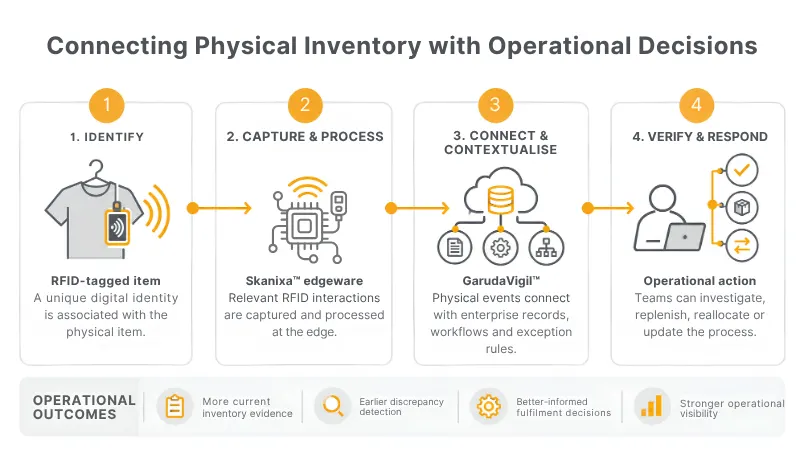
The objective is not simply to generate more inventory data.
It is to help retailers establish where additional physical verification can make existing inventory decisions more dependable.
Not every inventory problem needs RFID
There is also a practical question that should precede any deployment: where would additional item-level verification create enough value to justify its cost?
A retailer with highly reliable receiving processes may gain little from adding another verification layer at that stage.
The opportunity may instead lie in sales-floor stocktaking, backroom inventory verification, store-based ecommerce fulfilment or other activities where manual checks are time-consuming and discrepancies have measurable consequences.
The economics will also vary by product category.
High-volume apparel and footwear operations may present a different case from low-value merchandise, bulk goods or products that are already efficiently controlled through existing processes.
RFID performance itself depends on appropriate tags, reader configuration, the surrounding materials and the workflow being supported.
A sensible starting point is therefore not an enterprise-wide technology rollout. It is identifying a specific operational problem, measuring its current cost and testing whether RFID-enabled verification improves the outcome.
The real question for festive readiness
Festive demand does not automatically make a retailer’s existing inventory systems inadequate.
It can, however, expose the limits of how frequently and efficiently the business can verify physical inventory while continuing to fulfil orders at speed.
That is a different problem from simply having inaccurate stock records.
For retailers with mature ERP, WMS and omnichannel systems, the next improvement may not come from replacing the platforms that manage inventory. It may come from strengthening the physical evidence those platforms depend upon.
The opportunity for RFID lies in making that evidence easier to capture, more frequent where necessary and more useful for operational decisions.
The question is not whether retailers already know how to manage inventory. It is whether their methods of verifying physical inventory can keep pace when demand accelerates.
And that is worth examining before the next peak season.
Explore the RFID opportunity in your retail operations
Where does physical inventory verification become most difficult in your existing workflows?
Connect with i-TEK to evaluate specific inventory processes, identify measurable visibility gaps and assess whether RFID-enabled verification can improve operational performance.